

Wednesday, December 06, 2006
Winterfest 2006
I had a particularly good time at the San Francisco Bicycle Coalition's Winterfest this year, but I don't know how to explain why. I was busy. The company and conversation were outstanding. I felt on my game. The beer was really tasty. On the other hand, they seem to have decided to gear it towards the auctions and reduce many other forms of entertainment. Last year I enjoyed the films, but maybe they ended up being a social crutch. Here is photo of my from the photo booth (something they do every year).


Sunday, December 03, 2006
NeXmap Review, etc.
My hands are all messed up from sailing. I need to get some sailing gloves, and I hear they do exist. My hands feel like sand paper. But the weather was beautiful, and my fellow sailors sweet. We took out a Precision, which doesn’t steer with much. I think I’ll try to stick with the Lidos for a bit longer.
I had a lot of competing invitations last night, but ultimately I decided to go to Kristin’s video art show. It seemed important to support her in this project, and also I thought I would enjoy it (of course). It was called “NeXmap: New Experimental Music, Art, Performance” in the “recombinant media labs”, this cool space south of Market. They showed 6 pieces.
In the first one, a violinist played notes (music) and computer responded with harmonizing or dissonant notes. I believe they were the result of the computer processing her sounds. The effect was really interesting. At the same time, a Durer etching was projected on the screens (along the entire wall of the space, 360 degrees), first so blown up that all you saw were a few pixels, then slowly we got to see the image until it became so small that it was a tiny, quivering dot on a black screen.
The second piece was a series of photos and recordings of people in urban settings. It was called “a strange intimacy”, and seemed to be about how, in urban settings, we are always surrounded by people we don’t know, and maybe we like it that way. He talked about the closeness of it, but I also wonder about the alienation of it.
In another piece, a Claronetist played very powerful music called “Dust” which he said was about 9/11. Kristin’s piece was 5th, and she had edited a dance performance into waves so that it looked like the dancers were rolling into and out of the water.
Julie said that the final piece made her feel like she was in hell. (She arrived with a headache.) The room was black, and we lay on the floor. The composer said it was about the Tsnami in Thailand. It sounded like huge rats crawling in the walls and floor and ceiling all around us. As the music built, and became more frantic, I began to feel unsafe. It was a tremendous feeling. But then I remembered that I was in a black room in downtown San Francisco at a music performance. Of course I was safe – these were just sounds. It made me wonder about our basic human reactions to other situations – maybe we’re nearly always safe. How much of modern life is simulated, and how much of it can be controlled and made to be a positive rather than negative experience through thought?
I thought about horror films and how I find them “too scary”. I like that they cause you to clutch the person next to you for “safety”. I like that they instigate human contact. Our world right now has so many fewer risks than when humans were more active members of wildlife. And yet, we find things to be afraid of anyway. We are afraid of our airplane falling from the sky, or of having our hearts broken by the careless, or of slipping in the shower. We’re afraid of having things we value taken from us. We’re afraid of dying too soon.
I always talk about letting go of these fears. “Forget safety,” I say. “Loosen your grip,” I think. But right now I realize that that disregards our most basic human programming, real or not. Feeling fear is part of being human. What that leaves is a question of how we react to our fears. Do we bomb foreign countries? Do we run away from Love? Do we stop bathing? Well, we all know the answers to these questions for ourselves, but I guess the thing I want to keep in mind is what these reactions mean and if they are an appropriate reaction to the real level of risk I face.
I had a lot of competing invitations last night, but ultimately I decided to go to Kristin’s video art show. It seemed important to support her in this project, and also I thought I would enjoy it (of course). It was called “NeXmap: New Experimental Music, Art, Performance” in the “recombinant media labs”, this cool space south of Market. They showed 6 pieces.
In the first one, a violinist played notes (music) and computer responded with harmonizing or dissonant notes. I believe they were the result of the computer processing her sounds. The effect was really interesting. At the same time, a Durer etching was projected on the screens (along the entire wall of the space, 360 degrees), first so blown up that all you saw were a few pixels, then slowly we got to see the image until it became so small that it was a tiny, quivering dot on a black screen.
The second piece was a series of photos and recordings of people in urban settings. It was called “a strange intimacy”, and seemed to be about how, in urban settings, we are always surrounded by people we don’t know, and maybe we like it that way. He talked about the closeness of it, but I also wonder about the alienation of it.
In another piece, a Claronetist played very powerful music called “Dust” which he said was about 9/11. Kristin’s piece was 5th, and she had edited a dance performance into waves so that it looked like the dancers were rolling into and out of the water.
Julie said that the final piece made her feel like she was in hell. (She arrived with a headache.) The room was black, and we lay on the floor. The composer said it was about the Tsnami in Thailand. It sounded like huge rats crawling in the walls and floor and ceiling all around us. As the music built, and became more frantic, I began to feel unsafe. It was a tremendous feeling. But then I remembered that I was in a black room in downtown San Francisco at a music performance. Of course I was safe – these were just sounds. It made me wonder about our basic human reactions to other situations – maybe we’re nearly always safe. How much of modern life is simulated, and how much of it can be controlled and made to be a positive rather than negative experience through thought?
I thought about horror films and how I find them “too scary”. I like that they cause you to clutch the person next to you for “safety”. I like that they instigate human contact. Our world right now has so many fewer risks than when humans were more active members of wildlife. And yet, we find things to be afraid of anyway. We are afraid of our airplane falling from the sky, or of having our hearts broken by the careless, or of slipping in the shower. We’re afraid of having things we value taken from us. We’re afraid of dying too soon.
I always talk about letting go of these fears. “Forget safety,” I say. “Loosen your grip,” I think. But right now I realize that that disregards our most basic human programming, real or not. Feeling fear is part of being human. What that leaves is a question of how we react to our fears. Do we bomb foreign countries? Do we run away from Love? Do we stop bathing? Well, we all know the answers to these questions for ourselves, but I guess the thing I want to keep in mind is what these reactions mean and if they are an appropriate reaction to the real level of risk I face.
Friday, December 01, 2006
Random quotes
If there’s an upside to freefalling, it’s that you give your friends a chance to catch you.
Grey’s Anatomy (TV show)
Each day, we must learn
again how to love…
Excerpt from "In the Middle" by Barbara Crooker, from Word Press. © 1998
…too full to swallow any sorrow…
The Joy Luck Club (the movie)
Grey’s Anatomy (TV show)
Each day, we must learn
again how to love…
Excerpt from "In the Middle" by Barbara Crooker, from Word Press. © 1998
…too full to swallow any sorrow…
The Joy Luck Club (the movie)
Sunday, November 26, 2006
Thanksgiving
I usually like to take some time around thanksgiving to articulate what I’m thankful for. This year, I found it difficult. I am thankful, but, in Laura’s words, I’ve been thrown a few curve balls lately. So, I guess that makes me more thankful for the things I am thankful for and less thankful for everything else.
Let’s see…. most of all, I’m thankful for my friends, my mother and my sister. I’m thankful for the Bay Area, and all the cool stuff you can do here, easily and inexpensively. I’m thankful that I have this really pretty and central apartment and that I’ve stayed here as long as I have (huge surprise!). I’m thankful for my skills and education (Have I been writing a lot of cover letters lately???). I’m thankful for passion. I’m thankful for the health of my loved ones and myself.
Kristin, Julie and I were talking last night about The Ring. What’s really scary about it is that you anticipate dying in 7 days – you have 7 days to worry about it. I’ve been reading this book, Stumbling on Happiness, where the author (Daniel Gilbert) asserts that anticipation of pleasure makes it possible to enjoy that pleasure more. Likewise, anticipation of the unpleasant (like dying from watching a video) is that much more so. I have flower bulbs growing in my apartment now, and I am thankful for their future blooms.
I had a really good Thanksgiving. I started my day with a yoga class – heated and involving sun salutations (2 things I don’t like) but refreshing anyway. Carolyn and I took a walk along the Bay Trail, which was so so beautiful and, of course, the conversation brilliant. I went with them to Tom’s briefly (fun!), and then walked up to Anne and Ray’s for my official Thanksgiving dinner.
About 10 people were there, and not surprisingly, they were particularly interesting. I sat next to a property manager from the Peninsula. We got to talking about traffic congestion and parking issues, and I got to bring out my "toolkit" for solving these problems. He seemed genuinely interested, and said he would try to push thru some of my suggestions in their larger buildings (which was my suggestion about where he should start). Hey, maybe I did something to save the world right there at the Thanksgiving table?!
I love this quote from Don DeLillo: "I've never thought about myself in terms of a career. ... I don't have a career, I have a typewriter." I love to work, to do stuff. I love to tell people about transportation alternatives, and solve their transportation (and other) problems. I love to figure stuff out. I’ve never been a very good American with this idea of a sacred “career” that you build and guard and cultivate like a plant… I think it’s a way to avoid living.
And from Sharon Olds: “I was a late bloomer. But anyone who blooms at all is very lucky.”
Let’s see…. most of all, I’m thankful for my friends, my mother and my sister. I’m thankful for the Bay Area, and all the cool stuff you can do here, easily and inexpensively. I’m thankful that I have this really pretty and central apartment and that I’ve stayed here as long as I have (huge surprise!). I’m thankful for my skills and education (Have I been writing a lot of cover letters lately???). I’m thankful for passion. I’m thankful for the health of my loved ones and myself.
Kristin, Julie and I were talking last night about The Ring. What’s really scary about it is that you anticipate dying in 7 days – you have 7 days to worry about it. I’ve been reading this book, Stumbling on Happiness, where the author (Daniel Gilbert) asserts that anticipation of pleasure makes it possible to enjoy that pleasure more. Likewise, anticipation of the unpleasant (like dying from watching a video) is that much more so. I have flower bulbs growing in my apartment now, and I am thankful for their future blooms.
I had a really good Thanksgiving. I started my day with a yoga class – heated and involving sun salutations (2 things I don’t like) but refreshing anyway. Carolyn and I took a walk along the Bay Trail, which was so so beautiful and, of course, the conversation brilliant. I went with them to Tom’s briefly (fun!), and then walked up to Anne and Ray’s for my official Thanksgiving dinner.
About 10 people were there, and not surprisingly, they were particularly interesting. I sat next to a property manager from the Peninsula. We got to talking about traffic congestion and parking issues, and I got to bring out my "toolkit" for solving these problems. He seemed genuinely interested, and said he would try to push thru some of my suggestions in their larger buildings (which was my suggestion about where he should start). Hey, maybe I did something to save the world right there at the Thanksgiving table?!
I love this quote from Don DeLillo: "I've never thought about myself in terms of a career. ... I don't have a career, I have a typewriter." I love to work, to do stuff. I love to tell people about transportation alternatives, and solve their transportation (and other) problems. I love to figure stuff out. I’ve never been a very good American with this idea of a sacred “career” that you build and guard and cultivate like a plant… I think it’s a way to avoid living.
And from Sharon Olds: “I was a late bloomer. But anyone who blooms at all is very lucky.”
Sunday, November 19, 2006
Life Goals 2006 (based on last new year's)
1. Live a life of constant Learning
2. Have True Love/a meaningful life Partnership
3. Have a baby or 2 and raise it/them well
4. Be a good Friend to 3-6 people at all times (partner included)
5. Live in a beautiful Home with a garden and a piano; grow tomatoes
6. Do something that helps people/makes the world a better place
7. See the world/have meaningful interactions with all kinds of people/have adventures/be open to what life offers
8. Be charming and talented
9. Be able to afford what I want (have money not be an issue – I don’t think it would ever happen to me that I would become too focused on accumulating wealth or living extravagantly; so, there’s no reason to have a goal on that)
10. Live in major cities around the world for 2+ years at a time
11. Care for my body/be healthy and fit
12. Make/do/produce good things
13. Strive to be low-impact on the planet
2. Have True Love/a meaningful life Partnership
3. Have a baby or 2 and raise it/them well
4. Be a good Friend to 3-6 people at all times (partner included)
5. Live in a beautiful Home with a garden and a piano; grow tomatoes
6. Do something that helps people/makes the world a better place
7. See the world/have meaningful interactions with all kinds of people/have adventures/be open to what life offers
8. Be charming and talented
9. Be able to afford what I want (have money not be an issue – I don’t think it would ever happen to me that I would become too focused on accumulating wealth or living extravagantly; so, there’s no reason to have a goal on that)
10. Live in major cities around the world for 2+ years at a time
11. Care for my body/be healthy and fit
12. Make/do/produce good things
13. Strive to be low-impact on the planet
Thursday, November 16, 2006
On Democracy in America
Last night, Brian and I went to see Steven Hill talk about his book "10 Steps to Repair American Democracy" at Modern Times Book Store. There has been a lot said on this subject ever since the debacle we call the 2000 presidential election (although I was overseas a good bit of time since then and a lot of what I heard said was said by Europeans. The French are completely convinced that American Democracy no longer exists). Yeah, so there’s a lot to say. But I was particularly compelled by one comment:
Steven Hill pointed out that Regan was the first politician to blame government for America’s problems. “Government is the problem,” he said. But, here’s the thing: if government is bad, then why vote? This sort of ideology, particularly when asserted by our Leaders, is hugely destructive not just to government, but to the public’s interest in participating in it. No wonder apathy is rampant – entire generations have heard this message since we were small.
Republicans value business to make the individual profit. Government serves the public without self-interest (except maybe people wanting to keep their jobs…?). What motivates us to serve each other, to make our world better, if the mechanism thru which we can do that is “the problem”. Sure, there are non-profits, but the non-profit structure, with battling board members, etc., contains the risk of preventing real leadership at that level either. Are we really destined to be a nation of individuals who only wish to make themselves rich at the expense of everyone else? Yet, without a mechanism to help people, we are left without other options.
At this point, I have jotted in my notes from the talk: “why do anything?” I like money just as much as the next guy, but there are so many ways to get there from here. If we don’t start with our fundamental beliefs – and figuring out what they are – how does anyone make a decision? (On the other hand, I get the feeling that everyone else is more decisive by nature than I am.)
I mentioned this to Brian after the talk, and he said that Katrina represented a shift in the American attitude towards government. Suddenly, everyone could see as plain as weather the need for competent representation. I’m hoping it’s a lasting effect.
I don’t know how to wrap up this post. I want to leave my readers with some really profound message, but exactly what it is eludes me. Government isn’t the problem. Government officials who blame the system which support them – those hypocrates – are the problem. And it is the responsibility of every single American to fight those messages, to make government better, to make it competent, to make it serve our needs, and to make sure every other American understands that. That’s our job. And if anyone supposedly representing us criticizes the system thru which they got that power, it’s our responsibility to impeach them.
Steven Hill pointed out that Regan was the first politician to blame government for America’s problems. “Government is the problem,” he said. But, here’s the thing: if government is bad, then why vote? This sort of ideology, particularly when asserted by our Leaders, is hugely destructive not just to government, but to the public’s interest in participating in it. No wonder apathy is rampant – entire generations have heard this message since we were small.
Republicans value business to make the individual profit. Government serves the public without self-interest (except maybe people wanting to keep their jobs…?). What motivates us to serve each other, to make our world better, if the mechanism thru which we can do that is “the problem”. Sure, there are non-profits, but the non-profit structure, with battling board members, etc., contains the risk of preventing real leadership at that level either. Are we really destined to be a nation of individuals who only wish to make themselves rich at the expense of everyone else? Yet, without a mechanism to help people, we are left without other options.
At this point, I have jotted in my notes from the talk: “why do anything?” I like money just as much as the next guy, but there are so many ways to get there from here. If we don’t start with our fundamental beliefs – and figuring out what they are – how does anyone make a decision? (On the other hand, I get the feeling that everyone else is more decisive by nature than I am.)
I mentioned this to Brian after the talk, and he said that Katrina represented a shift in the American attitude towards government. Suddenly, everyone could see as plain as weather the need for competent representation. I’m hoping it’s a lasting effect.
I don’t know how to wrap up this post. I want to leave my readers with some really profound message, but exactly what it is eludes me. Government isn’t the problem. Government officials who blame the system which support them – those hypocrates – are the problem. And it is the responsibility of every single American to fight those messages, to make government better, to make it competent, to make it serve our needs, and to make sure every other American understands that. That’s our job. And if anyone supposedly representing us criticizes the system thru which they got that power, it’s our responsibility to impeach them.
Human consciousness is like a bicycle?
I was just listening to my Scientific American podcast, and they were discussing the issues that came up at the recent World Science Forum (NYC). One was the idea that shortly, the technology will exist to make it possible for people to live forever. They mentioned people "downloading" their consciousness or even correcting "bugs" in the consciousness of their friends. This, of course, made me think of bicycles.
(Would this happen with ink blots?)
Years ago, I asked my friend James Hill who worked at the Missing Link bicycle shop how long he had had his bicycle. He shifted weight on his feet and said, that's a difficult question. What is a bicycle? You wear out parts and replace them. Is a bicycle its frame? But what if you switch all the parts from one frame to another? Likewise, if you get a new heart or kidney or "download" your consciousness to a new body, are you the same person?
I can't help but think that we are a different person (or bicycle) from one minute to the next. They say your cells turn over every 7 years (or something like that) that after 7 years you have none of the same cells that you had to begin with. Are you the same person bc you have the "same" consciousness? The same "soul"?
Some people just love to categorize. "You're intellectual" or "you’re sensitive" or "women have ESP and men don't". There are 2 kinds of people, and you're the first (whatever that is). When it’s stated seriously, this infuriates me. Keep your labels to yourself. I am the sky -- you can't fit me into any box. Likewise, if we are each a different entity from one moment to the next, we can't be categorized. Let go of the idea of separate self and embrace the idea of systemic self. We are each part of the economy, the political system, the eco-system, our community.... Isn't that a much more important, reliable identity?
(Would this happen with ink blots?)
Years ago, I asked my friend James Hill who worked at the Missing Link bicycle shop how long he had had his bicycle. He shifted weight on his feet and said, that's a difficult question. What is a bicycle? You wear out parts and replace them. Is a bicycle its frame? But what if you switch all the parts from one frame to another? Likewise, if you get a new heart or kidney or "download" your consciousness to a new body, are you the same person?
I can't help but think that we are a different person (or bicycle) from one minute to the next. They say your cells turn over every 7 years (or something like that) that after 7 years you have none of the same cells that you had to begin with. Are you the same person bc you have the "same" consciousness? The same "soul"?
Some people just love to categorize. "You're intellectual" or "you’re sensitive" or "women have ESP and men don't". There are 2 kinds of people, and you're the first (whatever that is). When it’s stated seriously, this infuriates me. Keep your labels to yourself. I am the sky -- you can't fit me into any box. Likewise, if we are each a different entity from one moment to the next, we can't be categorized. Let go of the idea of separate self and embrace the idea of systemic self. We are each part of the economy, the political system, the eco-system, our community.... Isn't that a much more important, reliable identity?
Tuesday, November 14, 2006
Random quote
Whereever there is injustice, oppression, and suffering, America will show up 6 months later and bomb the country next to where it's happening.
-P J O'Rourke
-P J O'Rourke
Monday, November 13, 2006
Wrapping-up Alaska, part 1
Yeah, I’m slow. I’ve taken up Sudoku, and I occasionally mutter to myself that I might developmentally delayed as I play. I love playing with Jared bc he catches my mistakes (“there’s no 8 there.”) and every time I get stuck he provides a number that jump-starts me again. He’s tried doing crosswords with me, but I am completely hopeless with any game involving words. Sudoku is a good compromise.
Anyway, I have one more story from our trip to Alaska and then some plugs. Jared’s parents kindly delivered us to Bellingham on the day of our ferry’s departure. It was a long drive and enormously generous of them to take us all that way. I had found a nice little 12-speed Peuget bicycle, but Jared didn’t have one yet. He arranged to meet a guy he’d found thru craigslist with a Specialized Hybrid for sale. It was fortunate that we were able to take care of that business at the last minute. A planner thru-and-thru, I felt anxious about this purchase not happening until hours before we left on the boat.
Jared’s parents unloaded us onto an industrial sidewalk, and I felt another pang of anxiety. If the parents leave, who will take care of us? At that moment, I felt like an 8-year old. I don’t know if anyone noticed my eyes filling with tears. When I told Jared later about this thought, he was a little offended. Didn’t I trust him to take care of us? How like a man.
The ferry was fantastic, and, as I mentioned before, I could happily live on one for quite a while. We had a couple days to read thru guidebooks and decide where we’d get off. I’d bought the ticket to Wrangell, but we talked ourselves into changing the first stop to Petersburg. Changing the ticket was easy, and didn’t cost much more. I was surprised.
The sun was setting when we disembarked in Petersburg, and immediately it began to rain. We’d asked a guy on the boat for directions, and began racing down one of the town’s few roadways in the wrong direction. About 20 minutes later, another guy we’d met on the boat pulled over in his truck next to us – it was dark and a little scary until we figured out we knew him – it turned out that 1) we were going the wrong way (as I mentioned) and 2) the campground was closed. He suggested we camp illegally (and even had a spot picked out for us), but after heading back into town (it was getting quite late!) I cast a strong vote for camping at the divvy RV park in town.
The RV park was incredibly muddy, and imbedded in the mud was broken glass (and who knows what else – used syringes?). The shared bathroom was dirty and broken. Some down-and-out souls lived there, either in their RVs or, in some unfortunate cases, in tents with various contraptions elevating and sheltering them from the constant rain. I tried to imagine how a person could fall on so much bad luck as to live here, and I could only think that mental illness or substance abuse must be involved. One man lived next to our tent with a whole little set up, and while he sat a few feet from us the entire evening, he just stared off into the corner. I was surprised when he responded in normal-sounding English when we asked him a question.
We woke up before daybreak and broke camp never tracking down our landlords to pay the $5 we owed them for sleeping there, criminals already so early in our vacation. I don’t know if it was the weather or my mood, but the supposedly-pretty and pleasant town seemed more sad to me. We had a “real” breakfast by the boats (there was only one possible place) and killed some time before the Ranger’s office opened. The plan was to find out about available cabins in the area.
This story is already way too long, and I haven’t even gotten to the point yet. I guess I’ll go ahead and post this in hopes of writing the rest later.
Anyway, I have one more story from our trip to Alaska and then some plugs. Jared’s parents kindly delivered us to Bellingham on the day of our ferry’s departure. It was a long drive and enormously generous of them to take us all that way. I had found a nice little 12-speed Peuget bicycle, but Jared didn’t have one yet. He arranged to meet a guy he’d found thru craigslist with a Specialized Hybrid for sale. It was fortunate that we were able to take care of that business at the last minute. A planner thru-and-thru, I felt anxious about this purchase not happening until hours before we left on the boat.
Jared’s parents unloaded us onto an industrial sidewalk, and I felt another pang of anxiety. If the parents leave, who will take care of us? At that moment, I felt like an 8-year old. I don’t know if anyone noticed my eyes filling with tears. When I told Jared later about this thought, he was a little offended. Didn’t I trust him to take care of us? How like a man.
The ferry was fantastic, and, as I mentioned before, I could happily live on one for quite a while. We had a couple days to read thru guidebooks and decide where we’d get off. I’d bought the ticket to Wrangell, but we talked ourselves into changing the first stop to Petersburg. Changing the ticket was easy, and didn’t cost much more. I was surprised.
The sun was setting when we disembarked in Petersburg, and immediately it began to rain. We’d asked a guy on the boat for directions, and began racing down one of the town’s few roadways in the wrong direction. About 20 minutes later, another guy we’d met on the boat pulled over in his truck next to us – it was dark and a little scary until we figured out we knew him – it turned out that 1) we were going the wrong way (as I mentioned) and 2) the campground was closed. He suggested we camp illegally (and even had a spot picked out for us), but after heading back into town (it was getting quite late!) I cast a strong vote for camping at the divvy RV park in town.
The RV park was incredibly muddy, and imbedded in the mud was broken glass (and who knows what else – used syringes?). The shared bathroom was dirty and broken. Some down-and-out souls lived there, either in their RVs or, in some unfortunate cases, in tents with various contraptions elevating and sheltering them from the constant rain. I tried to imagine how a person could fall on so much bad luck as to live here, and I could only think that mental illness or substance abuse must be involved. One man lived next to our tent with a whole little set up, and while he sat a few feet from us the entire evening, he just stared off into the corner. I was surprised when he responded in normal-sounding English when we asked him a question.
We woke up before daybreak and broke camp never tracking down our landlords to pay the $5 we owed them for sleeping there, criminals already so early in our vacation. I don’t know if it was the weather or my mood, but the supposedly-pretty and pleasant town seemed more sad to me. We had a “real” breakfast by the boats (there was only one possible place) and killed some time before the Ranger’s office opened. The plan was to find out about available cabins in the area.
This story is already way too long, and I haven’t even gotten to the point yet. I guess I’ll go ahead and post this in hopes of writing the rest later.
Friday, November 03, 2006
My new bicycle

Jared gave me this bicycle for my birthday. I think it's the prettiest bicycle I have ever seen.
Thursday, November 02, 2006
Green Challenge
Slate Green Challenge: Your eight-week carbon diet
My annual carbon emissions are 16,556.2 lbs.
Average carbon emissions per year, per person:
United States: 44,312
Qatar: 117,064
France: 13,668
India: 2,645
Kenya: 440
So, you can see, I have some work to do. You should play too.
My annual carbon emissions are 16,556.2 lbs.
Average carbon emissions per year, per person:
United States: 44,312
Qatar: 117,064
France: 13,668
India: 2,645
Kenya: 440
So, you can see, I have some work to do. You should play too.
Friday, October 27, 2006
SF's best fish and chips
Aparently this is a difficult question. I picked up a Contra Costa Times on the BART the other day and found an article about the best places to get fish and chips in their areas. Two of those places are geographically desirable to me:
Spenger's in Berkeley (been there many times as a kid)
Sea Salt on San Pablo in Berkeley (never heard of it, but interested)
In San Francisco, Edinburgh Castle was mentioned several times in my google search. I took Jared there recently and thought it was just OK. I think there had been a problem getting the food from the little store around the corner to the pub. Other places mentioned:
The Liberties on Guerrero at 22nd (been there, don't remember what I ordered)
Wilde Oscar's on Folsom at 15th (never been there, but interested now)
But, I don't know. After Alaska, I may be spoiled for the best fish and chips California has the offer.
Spenger's in Berkeley (been there many times as a kid)
Sea Salt on San Pablo in Berkeley (never heard of it, but interested)
In San Francisco, Edinburgh Castle was mentioned several times in my google search. I took Jared there recently and thought it was just OK. I think there had been a problem getting the food from the little store around the corner to the pub. Other places mentioned:
The Liberties on Guerrero at 22nd (been there, don't remember what I ordered)
Wilde Oscar's on Folsom at 15th (never been there, but interested now)
But, I don't know. After Alaska, I may be spoiled for the best fish and chips California has the offer.
Monday, October 16, 2006
Marriage trends a-changin'
....The survey revealed wide disparities in household composition by place. The proportion of married couples ranged from more than 69 percent in Utah County, Utah, which includes Provo, to 26 percent in Manhattan, which has a smaller share of married couples than almost anyplace in the country. But Manhattan registered a 1.2 percent increase in married couples since 2000, in contrast to the rest of New York City and many other places.
* Among counties, the highest proportion of unmarried opposite-sex partners was in Mendocino, Calif., where they made up nearly 11 percent of all households.
* The highest share of male couples was in San Francisco, where, according to the census, they accounted for nearly 2 percent of all households. In Manhattan, they made up 1 percent of households.
* Hampshire County, Mass., home to Northampton, had the highest proportion of female couples, at 1.7 percent.
...
A number of couples interviewed agreed that cohabiting was akin to taking a test drive and, given the scarcity of affordable apartments and homes, also a matter of convenience. Some said that pregnancy was the only thing that would prompt them to make a legal commitment soon. Others said they never intended to marry. A few of those couples said they were inspired by solidarity with gay and lesbian couples who cannot legally marry in most states.
NYT
* Among counties, the highest proportion of unmarried opposite-sex partners was in Mendocino, Calif., where they made up nearly 11 percent of all households.
* The highest share of male couples was in San Francisco, where, according to the census, they accounted for nearly 2 percent of all households. In Manhattan, they made up 1 percent of households.
* Hampshire County, Mass., home to Northampton, had the highest proportion of female couples, at 1.7 percent.
...
A number of couples interviewed agreed that cohabiting was akin to taking a test drive and, given the scarcity of affordable apartments and homes, also a matter of convenience. Some said that pregnancy was the only thing that would prompt them to make a legal commitment soon. Others said they never intended to marry. A few of those couples said they were inspired by solidarity with gay and lesbian couples who cannot legally marry in most states.
NYT
Friday, October 13, 2006


Ilana in Ecuador
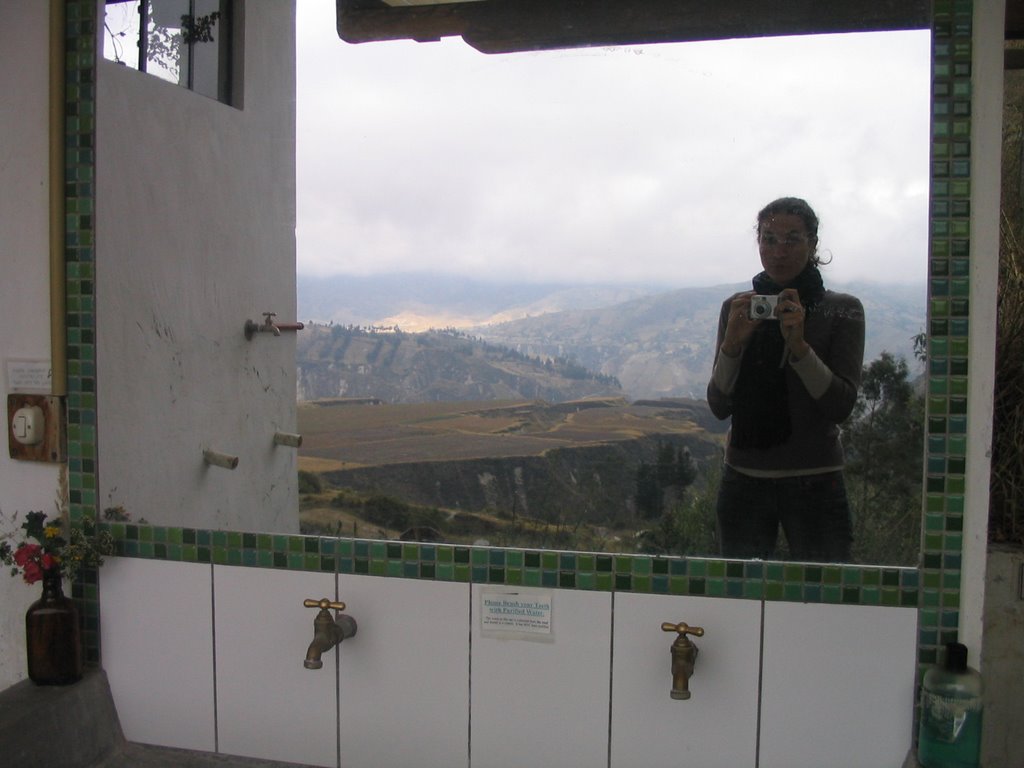
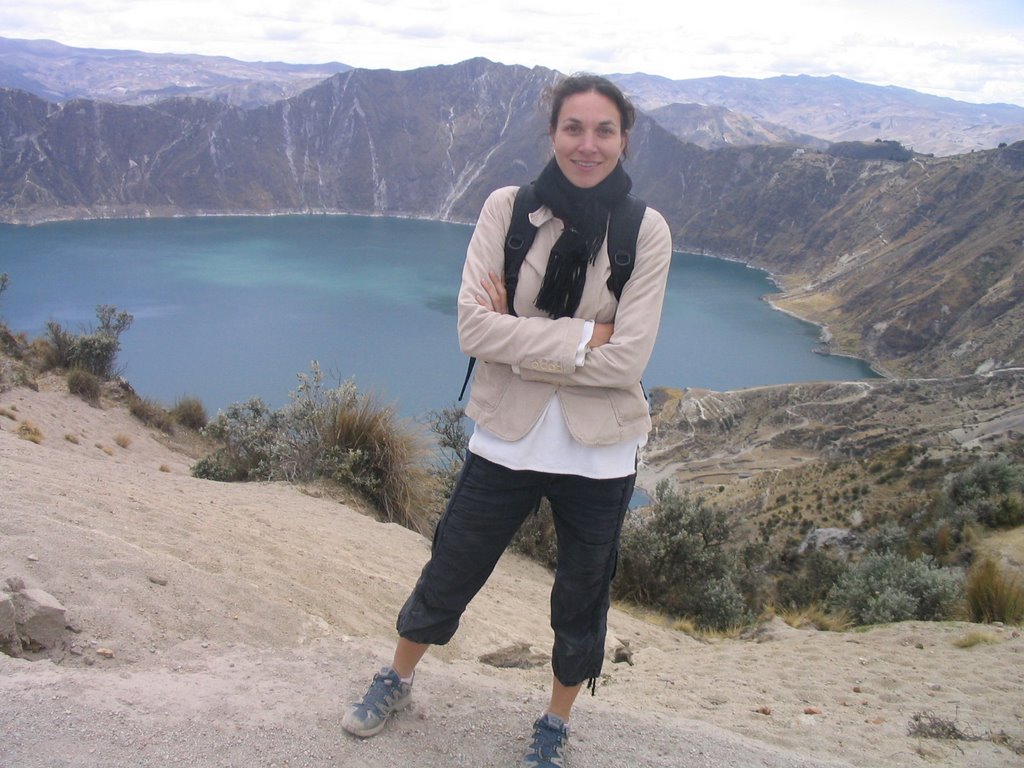
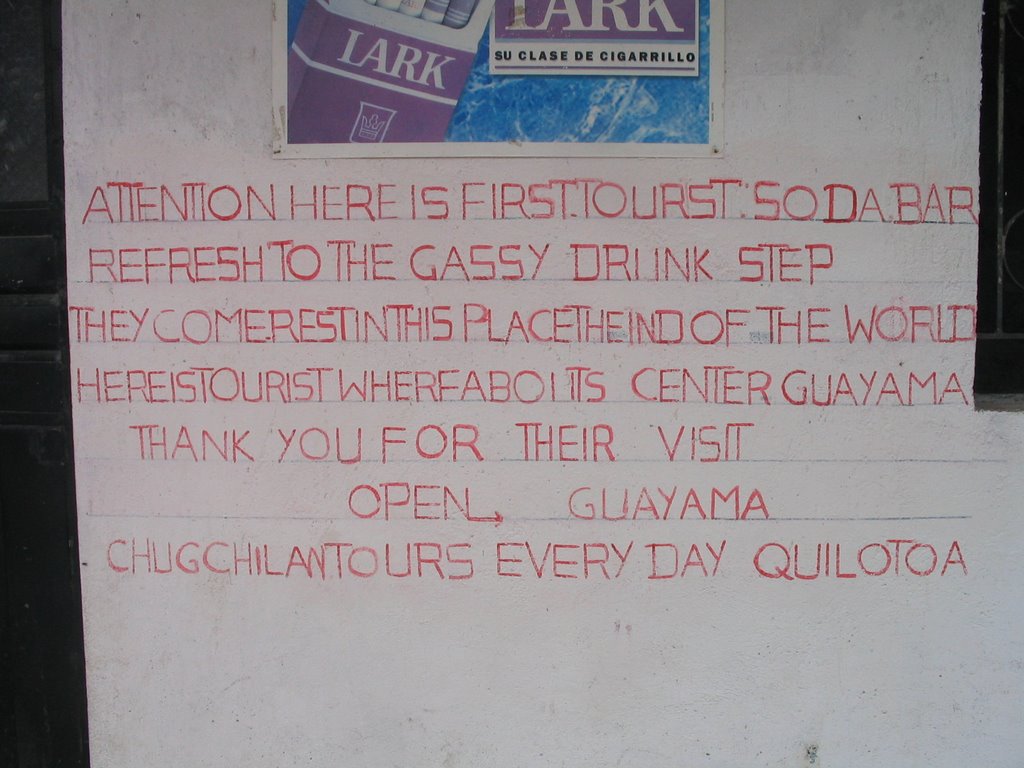
Ilana says: Here are a couple of pictures from Ecuador. The first is the view from my bathroom (literally) in Chugchilan. The second is the volcanic lagoon of Quilotoa (remember the volacanic lagoon in Omatepe, Lilia?), and the last is my favorite sign in Ecuador, in a teensy village I hiked through, Guayambe I think it was called.
Thursday, October 12, 2006
Failure is a Good Thing by Jon Carroll
Success is boring. Success is proving that you can do something that you already know you can do… Failure is how we learn.
The first time I played pool, I won. I explained to my friends that it's because I have an innate understanding of physics. I'm a spatial thinker. Alas. I never won again.
When my little sister was born, they gave her a bunch of tests as they do all babies. She came out low in one, and although I was 4 at the time, I remembered this. I had been a perfect baby. She, despite taking all the attention away from me, was not. As soon as she was old enough to understand, I explained this to her: she is an inferior person; in order to keep up with everyone else, she would have to work a lot harder.
So, here's the funny part: she did (work a lot harder). She's done everything I've done, but better. She's multilingual; I am not. My Master's is from Berkeley; her's Harvard. I went to a small liberal arts college in New England; she went to a better one. I've traveled around the world; she's been to 5 countries in the last 3 weeks. I chose a profession to help people (transportation planning); so did she (international education policy). Despite this paragraph, we aren't competitive. She cares more, works harder than I do, and I respect her for that.
Because of what I told her about herself (which was false, by the way) she expected to fail at first, to have to try harder. Based on my 4-year-old understanding of these tests, I always thought everything would come to me easily, because I was a perfect baby. So, Maybe I'm afraid to fail, afraid to try too hard in case I did fail. I believe that this particular form of sibling torture did her a huge favor.
I don't really have a point other than that, if we would all just embrace failure, maybe we'd all be a lot happier and more successful.
The first time I played pool, I won. I explained to my friends that it's because I have an innate understanding of physics. I'm a spatial thinker. Alas. I never won again.
When my little sister was born, they gave her a bunch of tests as they do all babies. She came out low in one, and although I was 4 at the time, I remembered this. I had been a perfect baby. She, despite taking all the attention away from me, was not. As soon as she was old enough to understand, I explained this to her: she is an inferior person; in order to keep up with everyone else, she would have to work a lot harder.
So, here's the funny part: she did (work a lot harder). She's done everything I've done, but better. She's multilingual; I am not. My Master's is from Berkeley; her's Harvard. I went to a small liberal arts college in New England; she went to a better one. I've traveled around the world; she's been to 5 countries in the last 3 weeks. I chose a profession to help people (transportation planning); so did she (international education policy). Despite this paragraph, we aren't competitive. She cares more, works harder than I do, and I respect her for that.
Because of what I told her about herself (which was false, by the way) she expected to fail at first, to have to try harder. Based on my 4-year-old understanding of these tests, I always thought everything would come to me easily, because I was a perfect baby. So, Maybe I'm afraid to fail, afraid to try too hard in case I did fail. I believe that this particular form of sibling torture did her a huge favor.
I don't really have a point other than that, if we would all just embrace failure, maybe we'd all be a lot happier and more successful.
Mary Karr and Calvin Trillin on Memoir, A City Arts and Lectures event
Last night, we went to see Calvin Trillin and Mary Karr talk about memoir as part of the City Arts and Lectures series (benefiting 826 Valencia, a NPO helping students 6-18 learn to write). DeAnne gave me the tickets bc at the last minute she couldn’t make it (had to go to LA for work). Jon Carroll introduced Mary Karr as the person who wrote “The Liars Club” and many many books of poetry. He introduced Calvin Trillin as the person who wrote half the magazine articles you’ve read in your life. He also wrote a memoir about his late wife, Alice.
Mary Karr was quick-witted and funny. Calvin Trillin was funny too, but not at all quick. It took some time to get into the rhythm of his speaking pattern and humor, but once we did he was mesmerizing. I hung on his every pause. Per DeAnne’s request, I took notes.
• MK thought she put everything she knew in her first book. Now she’s on her third.
• Jon Carroll asked if any family members or neighbors objected to the ugly things she said in her book. She said everyone knew those things. For example, the fact that her mother tried to stab her, well, she knew that she did that. It wasn’t a high point in her parenting, but it happened, and it went into the book. Likewise, that MK said that the TX town she grew up in was ugly – everyone living there knows that even though they’re from TX.
• Along the same lines, she said that she loves her mother, that 40-some-odd years of being loved by her mother wasn’t negated by this one incident where her mother tried to stab her.
• CT wrote an article about his wife where he made her a sitcom character. The book was to make her real.
• For (memoir) writers, family members are the collateral damage of war. CT said that the Dostoyevsky Rule gives you the right to tell your family’s secrets. That is, if there’s a chance you’re as great a writer as Dostoyevsky, you are entitled to share your family’s secrets. If there’s no chance of that, you aren’t entitled to it.
• MK: Memoir is different than therapy bc when you write a memoir they pay you.
• Reading memoir, or any portrayal of family (Jerry Springer? Father Knows Best?) puts your family on a spectrum with other families: you know yours is not as “perfect” or as “crazy” as that one.
• Literature makes us a community. It connects us. You read about other peoples’ families, and you can relate to their issues and learn from their experiences.
• Memory is the pellet that you put in the water of memoir and it blooms into a flower (like the kind you would get at a circus).
• CT: Your family becomes the characters in your novel. You take away their ability to write their own stories about your shared history.
• The “Quirky Beast” (such as the New Yorker) – if you tinker with it, it will fall apart. But understanding how it works now is impossible.
• A member of the audience mentioned Jon Carroll’s recent NPR piece on the benefits of failure (I am very interested in this idea.) and asked the writers about theirs.
o MK gave a few examples. One was that she is now a Guggenheim Fellow. She applied for that fellowship 18 times!
o CT described an article he wrote about a small island country called Naru. It’s on mineral deposits and turned out to be more valuable for minerals than as a country. The New Yorker bought it, but never printed it. He recently learned that they use that article to test people who want to work for the New Yorker as a copy editor. An audience member pointed out that, like the country, his article was more valuable as a copy editing test (minerals) than its intended purpose (reading pleasure, or a country).
• Another audience member mentioned that her family loves to read CT’s poetry in The Nation together.
Jared has… mentioned… my disclosures (he said he feels like Jerry Springer’s wife), and I wonder if this event helped him understand where I’m coming from a little better. I want to look into this idea of the benefits of failure some more….
Mary Karr was quick-witted and funny. Calvin Trillin was funny too, but not at all quick. It took some time to get into the rhythm of his speaking pattern and humor, but once we did he was mesmerizing. I hung on his every pause. Per DeAnne’s request, I took notes.
• MK thought she put everything she knew in her first book. Now she’s on her third.
• Jon Carroll asked if any family members or neighbors objected to the ugly things she said in her book. She said everyone knew those things. For example, the fact that her mother tried to stab her, well, she knew that she did that. It wasn’t a high point in her parenting, but it happened, and it went into the book. Likewise, that MK said that the TX town she grew up in was ugly – everyone living there knows that even though they’re from TX.
• Along the same lines, she said that she loves her mother, that 40-some-odd years of being loved by her mother wasn’t negated by this one incident where her mother tried to stab her.
• CT wrote an article about his wife where he made her a sitcom character. The book was to make her real.
• For (memoir) writers, family members are the collateral damage of war. CT said that the Dostoyevsky Rule gives you the right to tell your family’s secrets. That is, if there’s a chance you’re as great a writer as Dostoyevsky, you are entitled to share your family’s secrets. If there’s no chance of that, you aren’t entitled to it.
• MK: Memoir is different than therapy bc when you write a memoir they pay you.
• Reading memoir, or any portrayal of family (Jerry Springer? Father Knows Best?) puts your family on a spectrum with other families: you know yours is not as “perfect” or as “crazy” as that one.
• Literature makes us a community. It connects us. You read about other peoples’ families, and you can relate to their issues and learn from their experiences.
• Memory is the pellet that you put in the water of memoir and it blooms into a flower (like the kind you would get at a circus).
• CT: Your family becomes the characters in your novel. You take away their ability to write their own stories about your shared history.
• The “Quirky Beast” (such as the New Yorker) – if you tinker with it, it will fall apart. But understanding how it works now is impossible.
• A member of the audience mentioned Jon Carroll’s recent NPR piece on the benefits of failure (I am very interested in this idea.) and asked the writers about theirs.
o MK gave a few examples. One was that she is now a Guggenheim Fellow. She applied for that fellowship 18 times!
o CT described an article he wrote about a small island country called Naru. It’s on mineral deposits and turned out to be more valuable for minerals than as a country. The New Yorker bought it, but never printed it. He recently learned that they use that article to test people who want to work for the New Yorker as a copy editor. An audience member pointed out that, like the country, his article was more valuable as a copy editing test (minerals) than its intended purpose (reading pleasure, or a country).
• Another audience member mentioned that her family loves to read CT’s poetry in The Nation together.
Jared has… mentioned… my disclosures (he said he feels like Jerry Springer’s wife), and I wonder if this event helped him understand where I’m coming from a little better. I want to look into this idea of the benefits of failure some more….
Wednesday, October 04, 2006
Update
I owe you some more stories about AK. That said, I have been completely overwhelmed with 2 things:
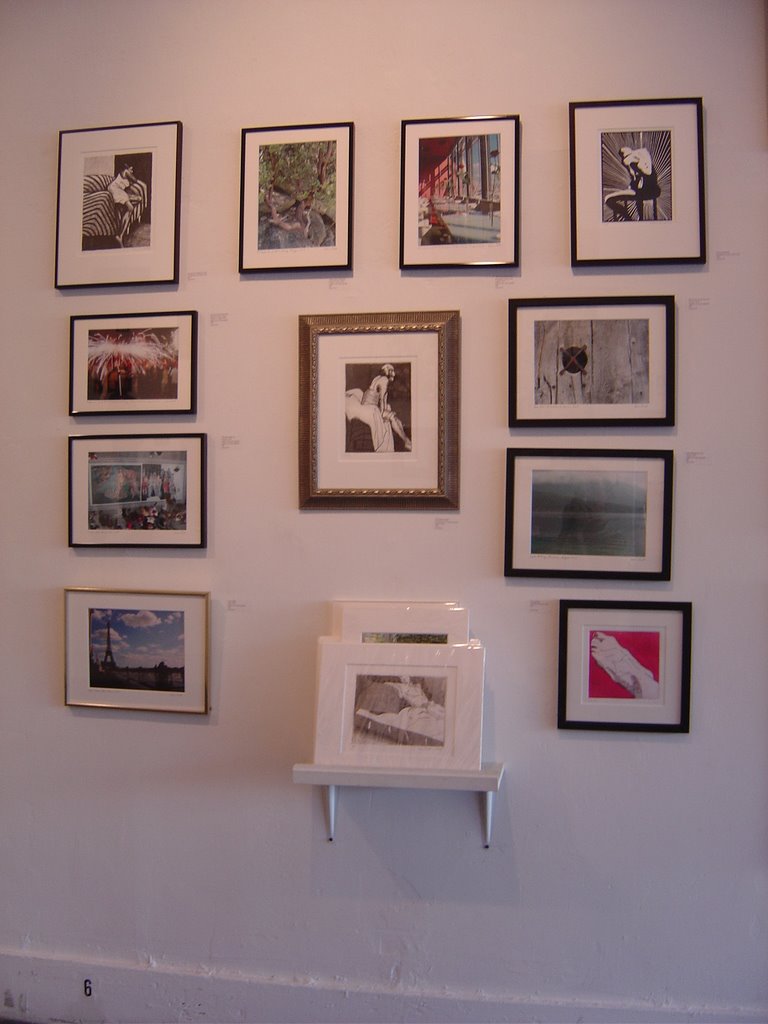
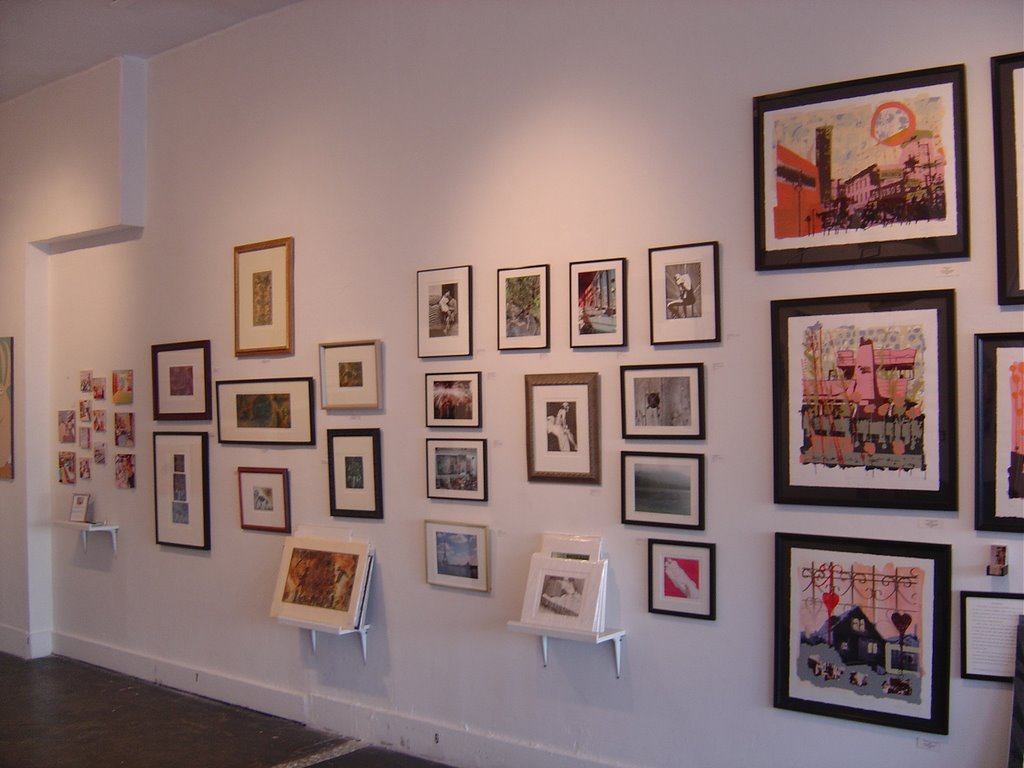
1) the gallery: my work is in the front room this month (cityartgallery.org). Since I have no new work (1), I had to spend a lot of time recycling and sorting to fill up my allotted wall space. We hung tonight (super fun!), and I feel pretty good about it. I have more work to do bf the opening on Friday (I hope you'll come!) but it feels generally under control.
2) the idea of a new bike: I have decided I want a bike with lugs, the prettier the better. So, I have been spending many hours every evening I'm not occupied searching ebay and craigslist. As you can imagine, Jared is incredibly supportive of this project. The other issue is that I noticed my Randonee doesn't fit me all that well -- it's too long. So, I have to check each bike not only for lugs and prettiness, but also for top tube length. I am going to be so knowledgeable by the time all this is thru!!!
The job search continues, and I feel optimistic about it. Just to hedge my bets, I'll apply for a few more jobs this week. Jared has had a nasty cold, but you know I am perfectly happy to sleep all the time. So, that works. Last week, I spent a big chunk of time working on a grant application for Gabe's film ("Less") about a homeless man.
I thought that selling my TV would get me to bed hours earlier. But, as you can see from the time of this post, nothing has changed.
(1) I am very excited about some of the stuff I'm working on, just not ready to put it on the walls....
1) the gallery: my work is in the front room this month (cityartgallery.org). Since I have no new work (1), I had to spend a lot of time recycling and sorting to fill up my allotted wall space. We hung tonight (super fun!), and I feel pretty good about it. I have more work to do bf the opening on Friday (I hope you'll come!) but it feels generally under control.
2) the idea of a new bike: I have decided I want a bike with lugs, the prettier the better. So, I have been spending many hours every evening I'm not occupied searching ebay and craigslist. As you can imagine, Jared is incredibly supportive of this project. The other issue is that I noticed my Randonee doesn't fit me all that well -- it's too long. So, I have to check each bike not only for lugs and prettiness, but also for top tube length. I am going to be so knowledgeable by the time all this is thru!!!
The job search continues, and I feel optimistic about it. Just to hedge my bets, I'll apply for a few more jobs this week. Jared has had a nasty cold, but you know I am perfectly happy to sleep all the time. So, that works. Last week, I spent a big chunk of time working on a grant application for Gabe's film ("Less") about a homeless man.
I thought that selling my TV would get me to bed hours earlier. But, as you can see from the time of this post, nothing has changed.
(1) I am very excited about some of the stuff I'm working on, just not ready to put it on the walls....
Subscribe to:
Posts (Atom)
